


Cairo, Mother of Cities
31 May 2026. Africa is often described as the mother of continents, the cradle of origins. From there, it is only a small step to see Cairo as the mother of cities. Egyptians themselves often call it Oum el-Dounia - “Mother of the World”: an urban matrix, an ancient hearth from which routes, knowledge and peoples seem to radiate.
In travellers’ accounts, Cairo already appears as a place of convergence. A fifteenth-century traveller, turning the pages of a Rihla - those narratives of roads and crossings that circulated from port to port, such as those of the famous Ibn Battuta - pauses upon its name: Al-Qahira, the Victorious. There he discovers an immense city where markets seem endless, where every trade finds its place, and where crowds cross paths without ever truly knowing one another. A crossroads of knowledge, exchange and passage, it is already multiple, already elusive.
Yet what strikes the reader in these descriptions is not merely its size or its wealth, but its ability to absorb the world, to contain it, to transform it into urban matter. Standing on the banks of the Nile, the vital artery of the continent, the Egyptian metropolis now overflows with more than twenty million inhabitants, as if this power of aggregation had never ceased.
Long before becoming a sprawling megacity, Cairo was already, in the Middle Ages, one of the great hinges of the world. At the intersection of caravan routes coming from Africa and maritime routes linking the Red Sea to the Indian Ocean, the city organized the circulation of people, wealth and ideas. Gold from Sudan and from distant lands connected to the Swahili coast, spices from India and textiles from the East all passed through Cairo before reaching the ports of the Mediterranean. In its souks and wikalas, merchants, intermediaries and travellers from several continents mingled in a continuous movement that made Cairo a global platform long before the term existed.
The city did not merely circulate goods. Around Al-Azhar Mosque, founded in the tenth century, grew one of the great intellectual centres of the Islamic world. Students and scholars from Africa, the Maghreb, the Levant and Asia brought with them their traditions, languages and interpretations. Trade routes and pilgrimage routes carried texts as much as they carried people. In libraries, madrasas and circles of learning, ideas were debated, transformed and transmitted.
Cairo was already a world city, not because of its size alone, but because of the intensity of the connections it forged between places. A city where movement also meant understanding, where exchange was a form of learning, and where dwelling took the shape of an expanded belonging stretching across several continents.
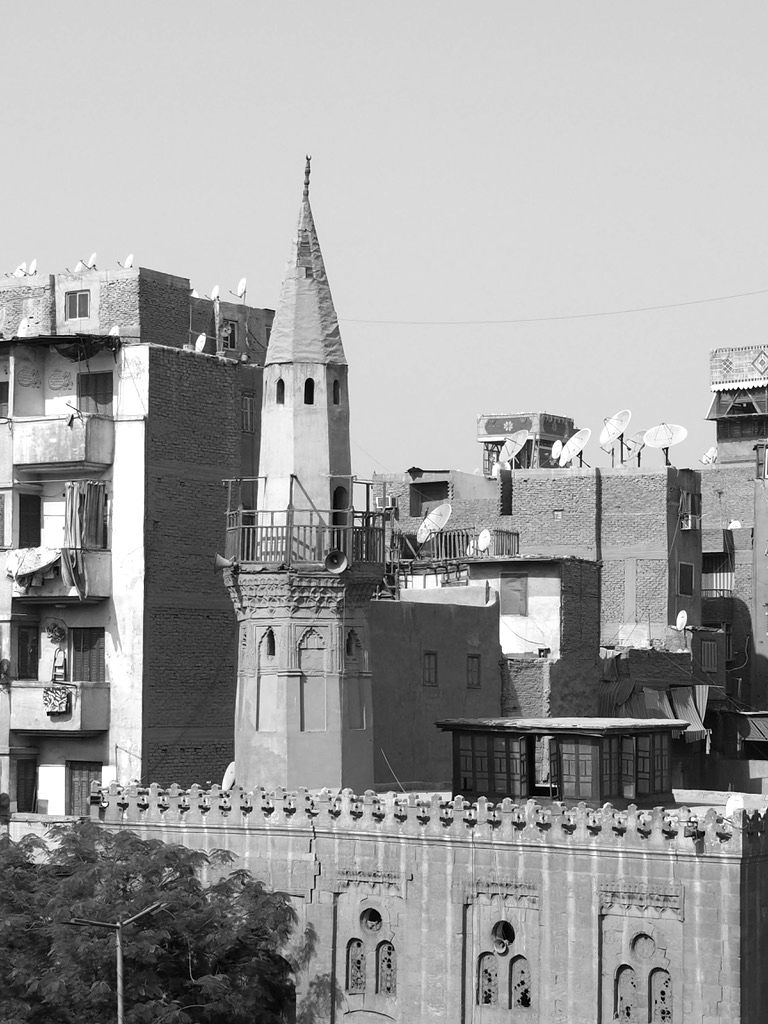
The city did not merely serve as a hub for the circulation of goods. Around Al-Azhar Mosque, founded in the tenth century, one of the great intellectual centres of the Islamic world emerged. Students and scholars from Africa, the Maghreb, the Levant and Asia brought with them their traditions, languages and interpretations. Trade and pilgrimage routes carried texts as much as they carried people. In libraries, madrasas and circles of learning, ideas were debated, transformed and transmitted.
Cairo was already a world city, not because of its size alone, but because of the intensity of the connections it forged between places. It was a city where movement also meant understanding, where exchange was a form of learning, and where dwelling took the shape of an expanded sense of belonging that stretched across several continents.

The Nile reaches Cairo after crossing lands of stone, sand and sun-scorched rock.
A long ribbon of water flowing from the heart of the continent, it carves a fertile green trace through the desert, without which no city could have emerged here. The White Nile, descending from the equatorial regions and the African Great Lakes, joins the Blue Nile, which flows from the Ethiopian highlands, at Khartoum before continuing its journey northward. When it reaches Cairo, the river seems to slow, widen and fragment into islands and branching channels—among them Zamalek and Manial, the most emblematic—as if still hesitating before dispersing into the Delta and the Mediterranean. Here, the mother stretches out her arms with remarkable elasticity. The Nile’s islands expand, and the city unfolds towards the edges of the desert: westward, towards new oases and cities risen from the sand; eastward, towards that Orient opening onto the routes of the Red Sea.
The Nile has carried people, stories, techniques and beliefs. Along its banks came the first farmers, learning to read the flood and master its rhythm. Later, feluccas travelled upstream and downstream laden with stone, grain and metals, linking kingdoms and cities within a shared inhabited space. It witnessed the gods of ancient Egypt, the scribes and the invention of writing, engineers and armies, merchants and pilgrims. It accompanied the transformations of empires, the arrival of new technologies and the slow evolution of societies. A nourishing river that became a corridor of circulation, and later the backbone of a metropolis, it has been continuously reinterpreted by human beings—controlled, diverted, measured and constrained.
The city was built within this shifting geography. Today the Nile is lined by concrete corniches, bridges suspended in dust and exhaust fumes, but also by gardens, fallen palaces, weathered modernist buildings and neighbourhoods inherited from every era. Cairo still bears the layers of the Fatimid and Mamluk dynasties, Ottoman traces, the Haussmann-inspired boulevards of Khedive Ismail modelled on Paris, colonial architecture, the modernist utopias of the twentieth century, and the endless extensions of the contemporary metropolis.
The city's brown urban fabric, punctuated here and there by lighter patches - vacant lots, undeveloped land and suspended construction sites - is pierced by major arteries that gradually branch into finer roads through which continuous streams of traffic flow. Where caravans once brought travellers, spices, textiles and provisions to the caravanserais and souks of Fatimid and Mamluk Cairo, millions of vehicles now move in an almost uninterrupted current.
Today, the city stretches for dozens of kilometres from east to west and from north to south, forming an immense conurbation that absorbs ancient villages, working-class neighbourhoods, luxury compounds, business districts, satellite towns and new cities. Almost nothing remains of the “15-minute city” in the sense described by Carlos Moreno. Cairo advances across the desert in successive layers, as if the river, transformed into a metropolis, continued to overflow its original bed.
Cairo has sometimes been called the “Paris of the Middle East”, with its boulevards, cafés and cosmopolitan spirit that fascinated nineteenth-century travellers. Yet Cairo has become an African and Eastern world city, an urban organism where caravans, empires, religions, knowledge systems and migrations have intersected for centuries. This complexity is captured, in its own way, by Alaa Al Aswany’s novel The Yacoubian Building. Through the lives unfolding on different floors of a single building, it reveals an entire city where nostalgia, frustrated aspirations, inequality and harsh adaptations coexist. A microcosm in which the question of dwelling emerges.
Cairo is in perpetual motion, a city of constant overflow. A city that always seems on the verge of collapse and yet continues to live with inexhaustible energy, sustained by the river that gave birth to it.
Perhaps Cairo is no longer a city but an urban expanse, stretching ever further, absorbing villages, modern oases and suburbs into a single breath. Today, more than twenty million inhabitants already make up this vast conurbation. Tomorrow, with the new capital rising from the desert, perhaps thirty million people will share the same urban horizon, its boundaries becoming ever more uncertain. By 2030, the city will already have changed scale. And perhaps, by the middle of the century, nearly thirty million inhabitants will occupy this territory stretched between valley and desert, within a metropolis whose contours increasingly escape measurement.
Cairo does not allow itself to be relocated so easily. Redirecting growth towards the desert was an immense ambition—perhaps one of the largest urban undertakings in the country's contemporary history. An attempt to relieve congestion, rationalise development and project a different image of the city. Yet this ambition is confronted by the reality of a metropolis whose trajectory is no longer entirely under control.
For Cairo today is caught in a series of tensions. A tension between memory and projection. Between an inherited city, shaped by centuries of history, and a planned city, conceived as a model. A tension between resource and constraint. The Nile, once the guarantor of balance, is becoming a source of uncertainty in the context of climate change. A tension between inclusion and exclusion. The new urban extensions - costly and remote - remain inaccessible to a large share of the population, while the existing city continues to densify, to become more fragile, and to absorb new inhabitants without pause.
And perhaps there is a deeper tension still. One that touches the very conditions of urban existence. Beyond forms, projects and narratives, a question imposes itself: under what conditions can Cairo still be inhabited?

To dwell here means more than simply occupying space. It requires access to water, to air, to mobility and to a minimum degree of stability. It requires continuity between places of living, working and care. It also requires belonging to a city that retains meaning. Yet this continuity is weakening. The historic city is reaching saturation. The extensions move ever farther away. Resources are becoming scarcer. Urban models overlap without always responding to one another.
Cairo remains an intensely inhabited city. But the conditions of that inhabitation are becoming increasingly uncertain. Perhaps this is where its future will be decided. Not in the ability to build more, farther and larger, but in the capacity to preserve—or rebuild—the conditions of existence that once made its emergence possible.
Today, Cairo can no longer be reduced to a city: it has become an urban condition. An extreme, yet revealing, expression of what contemporary metropolises are becoming. To live in Cairo is to negotiate with it, to adapt to its constraints. No longer to dwell in stability, but in movement—in a form of growth that escapes the conventional frameworks of planning. A city that expands faster than it can be imagined.
Today, Cairo has become a mirror in which the possible trajectories of twenty-first-century cities are reflected, a few years ahead and with greater intensity. Cairo, the mother of cities, is no longer merely an origin. Today, it is a question. How can a city born of a river, a memory and a fragile equilibrium continue to exist when those very foundations are undergoing profound transformation?
All pictures by the author. Text translated with the support of ai ChatGPT.


